
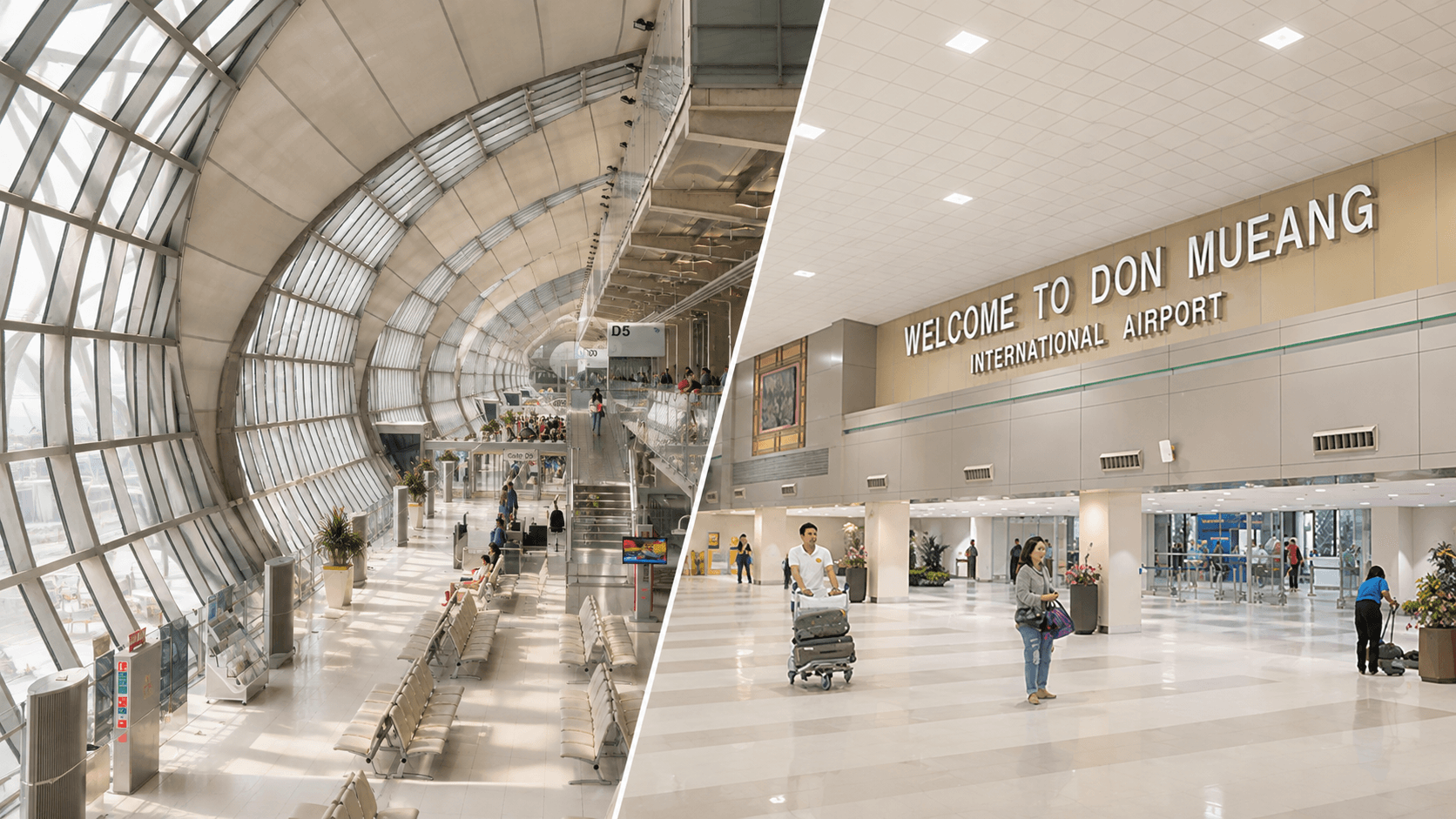
Here is a small, useful truth about Bangkok: most travellers never actually choose which airport they land at. Their airline chooses for them. What is worth knowing is how the two differ, so nothing on arrival catches you off guard.
This guide covers what sets Suvarnabhumi and Don Mueang apart, how to tell which one your flight uses, how to get into the city from each, and what to do if your trip involves both.
Two Airports, Two Personalities
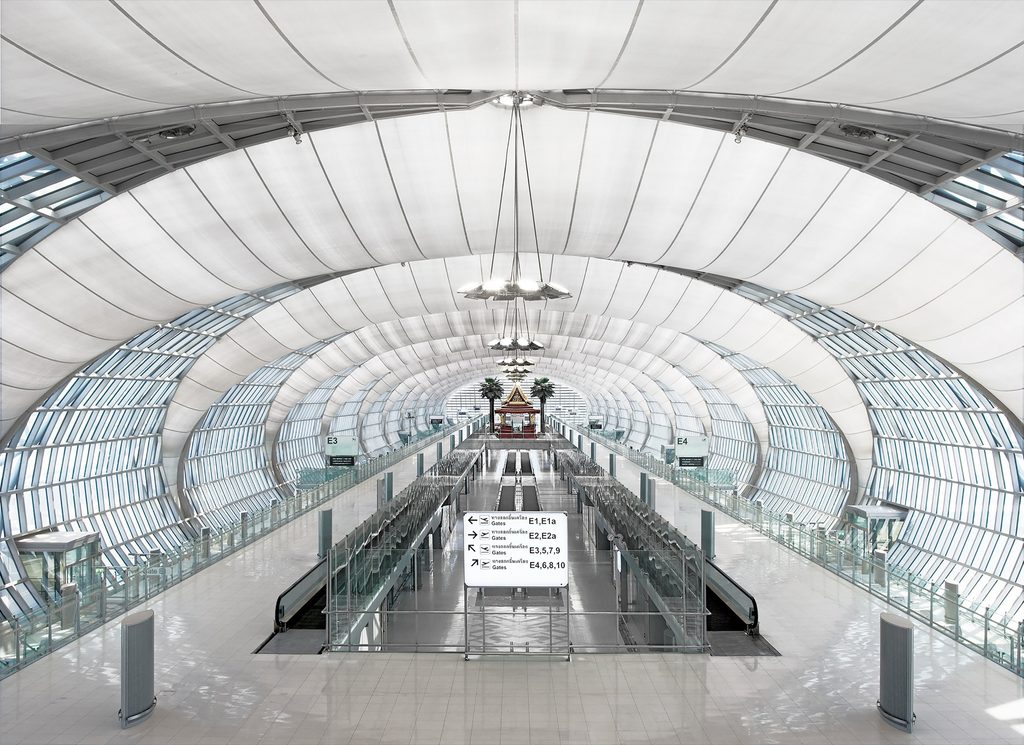
Suvarnabhumi (BKK) is the grand one. Its name means “golden land”, and the terminal lives up to it, all soaring glass and one of the tallest control towers in the world. Opened in 2006, it is Thailand’s main international gateway and the base for Thai Airways, Bangkok Airways and most long-haul carriers flying to Thailand.
Don Mueang (DMK) is the older, quieter sibling, and genuinely one of the oldest airports still operating anywhere in the world. It briefly closed when Suvarnabhumi opened, then reopened in 2007 and found a new purpose as Southeast Asia’s budget airline hub. It is smaller, simpler, and a little less polished, which some travellers actually prefer.
| Detail | Suvarnabhumi (BKK) | Don Mueang (DMK) |
|---|---|---|
| Location | Samut Prakan, east of Bangkok | Don Mueang district, north of Bangkok |
| Distance to city centre | About 25–30 km | About 20–25 km |
| Opened | 2006 | 1914 (reopened as a budget hub in 2007) |
| Mainly serves | Long-haul and full-service airlines | Low-cost and regional airlines |
| Official website | suvarnabhumi.airportthai.co.th | donmueang.airportthai.co.th |
Which One Is Your Airline Using?
This is really the answer to the whole question. Here is the rough rule of thumb:
- Suvarnabhumi (BKK): Thai Airways (its home hub), Bangkok Airways, Thai Vietjet, and almost every long-haul airline flying in from Europe, the Middle East, Australia or North America.
- Don Mueang (DMK): Thai AirAsia, Nok Air, Thai Lion Air and most regional budget carriers. Thai AirAsia now also runs some flights from Suvarnabhumi, so it pays to check your ticket rather than assume.
Booking a connecting flight? This is the detail that trips people up most. Always check that both legs use the same airport, since a flight advertised simply as “Bangkok” could land you at one and depart you from the other, with a fair journey between them. Planning a work trip around this? Our tips for business travellers in Bangkok cover scheduling around tight connections.
Getting into Bangkok from Each Airport
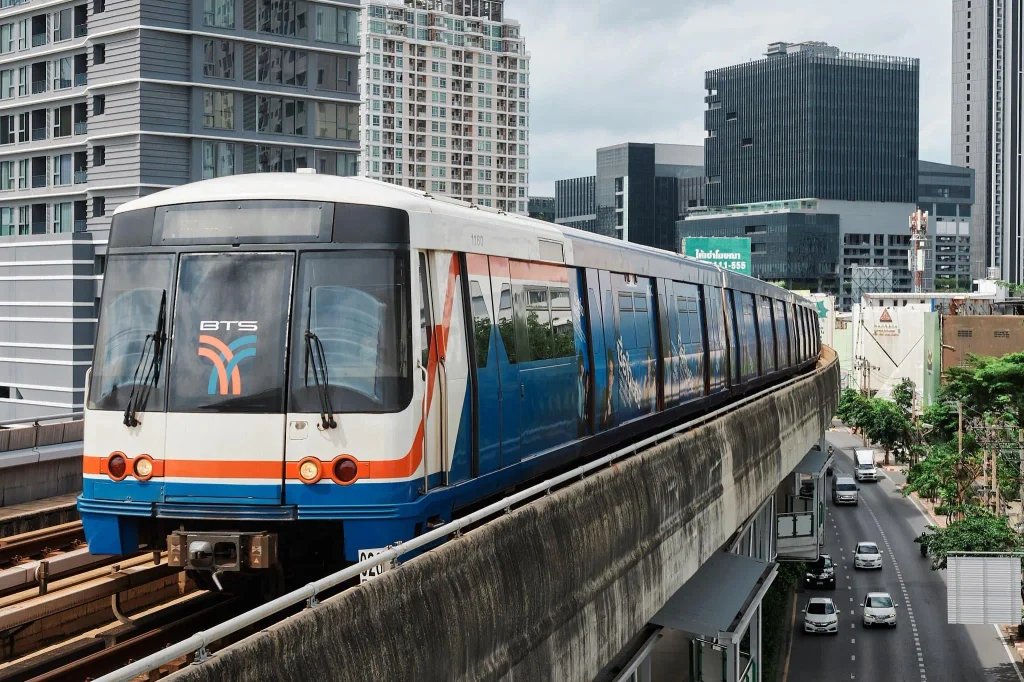
From Suvarnabhumi, the Airport Rail Link is the easiest way in: a smooth 26 to 30 minute ride to Phaya Thai, where it connects to the BTS Skytrain, for well under 50 THB.
From Don Mueang, the SRT Dark Red Line runs from a station a short covered skywalk from the terminal to Krung Thep Aphiwat Central Terminal, where it connects to the MRT Blue Line.
| Suvarnabhumi (BKK) | Don Mueang (DMK) | |
|---|---|---|
| Train | Airport Rail Link to Phaya Thai | SRT Dark Red Line to Krung Thep Aphiwat |
| Train journey time | 26–30 minutes | Roughly 20–25 minutes |
| Taxi journey time | 30–60 minutes, depending on traffic | 30–60 minutes, depending on traffic |
On paper, Don Mueang sits a little closer to central Bangkok. In practice, your actual route, your hotel’s location and the time of day matter more than the few kilometres between the two. Neither airport is reliably faster once traffic is added to the mix.
Connecting Between BKK and DMK
If your trip has you landing at one airport and flying out from the other, plan for a proper journey rather than a quick hop. A free shuttle bus runs between the two for passengers with a same-day ticket, though the trip can take an hour or more once you include waiting and traffic. There is no single direct train linking both airports yet, so a taxi or ride-hailing app is often the more predictable option if your connection is tight.
A tight connection is exactly where immigration queues hurt the most. Fast Track Thailand offers fast track at Suvarnabhumi and fast track at Don Mueang, so clearing the airport is one less variable to worry about. See how fast track compares to regular immigration at Suvarnabhumi if you want the full picture.
A Few Honest Arrival Tips
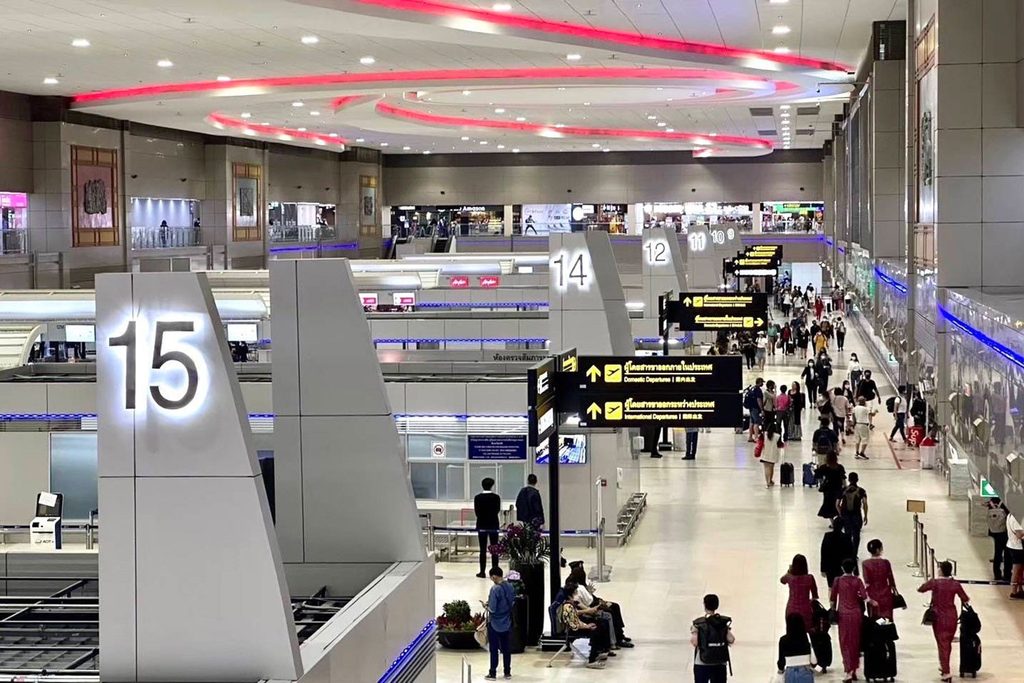
Suvarnabhumi is bigger, busier and can feel like a small city on a hectic day, so first-timers should allow a little extra time to find their way. Don Mueang, by contrast, is compact and genuinely walkable, the sort of place where you can see the exit from the moment you leave the plane. Neither is difficult once you have landed there once, and the entry rules are identical whichever one you fly into.
Getting your paperwork sorted before you land makes either airport simpler. See our step-by-step TDAC guide and our overview of Thailand immigration rules for what to expect at the counter.
Quick FAQ
Can I use the same visa-free entry at either airport?
Yes. Thailand’s entry rules, including the TDAC and visa-free stay, apply the same way at both airports.
Is one airport safer or more modern than the other?
Both are well run and safe. Suvarnabhumi is newer and larger, while Don Mueang is older and simpler, but neither has a safety disadvantage.
Do I need extra time if my connecting flight is at the other airport?
Yes. Build in at least two to three hours for the transfer itself, on top of your usual check-in time, since the journey between them is rarely instant.
Which airport is better for a long layover?
Suvarnabhumi has more lounges and facilities to pass the time comfortably. If you’re at Don Mueang, its compact size at least means you are never far from anything you need.
Either Way, a Smooth Landing
Whichever airport you fly into, the fundamentals of a good arrival stay the same: know your terminal, have your TDAC ready, and give yourself a little grace on timing.
Fast Track Thailand meets you at the gate at both Suvarnabhumi and Don Mueang, so your holiday or trip starts the moment you land. Explore the top benefits of fast track and our pricing.